
According to the American Alliance of Museums' 2025 Annual National Snapshot, nearly one-third of museums reported decreased attendance in 2025, and more than half of museums report lower attendance than in 2019. On top of declining attendance, one-third of museums have had government grants or contracts cancelled, with 67% of those reporting that the lost funding has not been replaced by other revenue streams.
In this challenging environment, every remaining revenue stream is more critical than ever. And for cultural organizations, one of them shows consistent strong performance: membership. The data is clear - your membership program should be a strategic priority.
How much is a member worth? The financial case for membership.
A member is worth, on average, four times more than a general admission visitor in a single year, and 4.5 times more over a decade.
Members are much more than just repeat visitors, they're one of your most valuable long-term financial relationships. In a decade-long study, IMPACTS Experience examined 18 cultural organizations, including museums, zoos, aquariums, and botanic gardens, among others, that had paid admission as well as a membership fee. The found that on average, a member is worth four times the value of a general admission visitor annually. Over time, the difference only widens, with the average member generating $727 in total value compared to $160 from a visitor, a difference of 4.5x.
The difference between a member and a visitor goes beyond the simple price tag of a membership fee. Members have a deeper, more connected relationship with your organization, and they make additional philanthropic donations at far higher rates than general visitors. IMPACTS found that the average member made an additional annual gift of $22.18, compared to just $1.80 from non-member visitors. While membership is a valuable revenue stream in its own right, it also represents a crucial step in the pipeline that transforms one-time visitors to generous donors. Membership offers your supporters a sense of investment in your work and a place in your community, preparing them for bigger asks in the future. When asked to give more, members often step up.
The financial case for building and investing in a strong membership program is clear - so how should cultural organizations go about creating, maintaining, and growing them? First, you need to understand the psychology of a member.
What motivates people to join a museum, zoo, or aquarium membership program?
Not all members join for the same reason, and which motivation drives the initial decision has a significant impact on long-term retention and giving.
Before making any changes to your current process, it is important to understand the psychology behind the membership decision. Not all members join for the same reasons, and how you make the ask matters. In another study of over 100 cultural organizations, IMPACTS Experience identified two distinct member types based on their core motivation:
- Transaction-based members join primarily for tangible benefits like free admission, gift shop discounts, and access to special events
- Mission-based members join because they want to support your work and feel genuinely connected to the purpose of your organization.
Both types of members are valuable, but mission-motivated members are often more loyal, more likely to renew, and more likely to make additional gifts. These members are your primary prospects for cultivation as mid-level donors, major donors, legacy donors, donors to capital campaigns, and more.
How can you identify which of your members fall into each category? Mission-oriented members display several unique behaviors to watch for. First, they're more likely to join at a higher level, opting for your top membership categories. This is a great clue that they are thinking of themselves as investors in your work, rather than bargain shoppers. Second, they're more likely to renew their membership. Long-time members who have renewed year after year are likely showing you that they have a deeper dedication to your work.
Understanding these two core motivations should guide the way you market your membership program. Focusing solely on transactional benefits like free admission will appeal to some potential members, but may not excite the mission-minded contingent who are your most valuable supporters. Instead, vary the language of your call-to-actions, with some focusing more heavily on mission-focused benefits and others promoting transactional benefits. Not only will this tactic ensure that you're appealing to both member categories, it will also help you understand from the beginning which category each member falls into.
One important note: these categories aren't static or set in stone. They exist on a spectrum, and can be fluid over time. Someone may join primarily for free admission, while also feeling a secondary sense of satisfaction in supporting your mission. Or someone may join because it is a good deal for their family at the time, and then visit repeatedly, developing a stronger dedication to your mission over time. From a fundraising standpoint, your goal should always be to cultivate connection to your mission in every supporter, no matter their initial reason for visiting or joining. Not only are members who feel connected to your work more valuable to your organization, they also perceive themselves as receiving more value from their membership. The same study found that members whose primary motivation was to support the organization, belong to the organization, and contribute to mission impact rated their membership as 14.5% more valuable for the cost than people who joined primarily for free admission, discounts, or event access. This supports what most fundraisers know intuitively: the emotional and psychological benefits of supporting cause-driven work are more powerful than transactional discounts. While some members join for transactional reasons, cultivating a relationship that also provides them with emotional benefits will increase their overall satisfaction and make them more likely to renew their membership for another year.
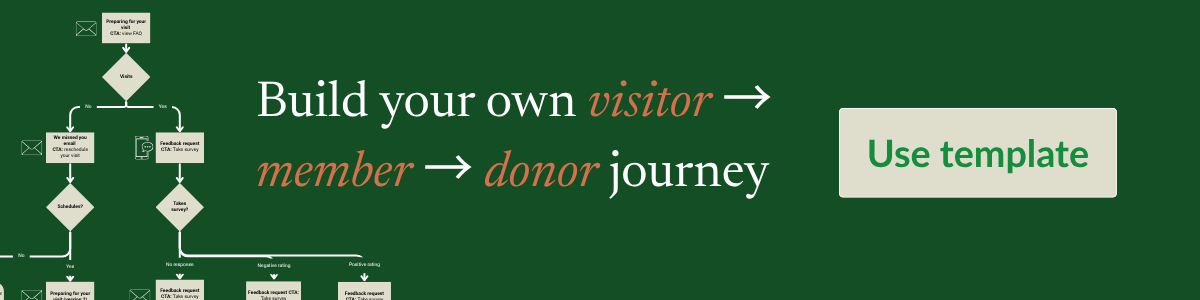
Map your visitor-to-member-to-donor journey. Understanding what motivates your members is step one. Mapping how they move from first visit to long-term donor is step two. Use our free Donor Journey Mapping Template to visualize every stage of your supporter pipeline and identify where members are falling through the cracks.
Converting visitors to members: proven tactics
The most effective membership programs are built through deliberate testing and experimentation, and the following tactics have been tested and proven for other museums, zoos, aquariums, and botanic gardens.
Every organization and membership program serves a different community and different mission, so the specific nuances of what motivate your visitors as a science and technology museum will naturally differ from those of a botanic garden. While broad principles of human psychology and motivation apply to almost any circumstance, the way that you apply them might look different from other organizations, and the most effective membership programs are built through deliberate experimentation and testing what works with your audience directly. That said, it helps to start with a foundation of some tried and true tactics, and refine from there. Here are a few proven tactics used by other museums, zoos, aquariums, and botanic gardens.
Treat your admissions counter as your first, and best, membership sales channel
On-site visitors are among the most qualified prospects a membership program has: they're already there, they've already demonstrated interest, and many have already paid for admission. They're not just interested in your organization, they're interested right now. To make the most of this moment, the Museum of Fine Arts Boston addressed this systematically, developing what they called a "Sequence of Service" - a standardized script for ticket desk staff that included asking every visitor about their membership status as a routine part of the transaction. They tested a dedicated professional sales team for a three-day period, saw a measurable lift in conversion, and ultimately hired their own team of 10 Membership Sales Associates, pairing them with new in-museum signage and a custom iPad app fully integrated with their frontline ticketing system for seamless on-the-spot membership sales. The result was consistently higher year-over-year conversion rates in the months that followed.
This tactic is a great example of holistic, strategic investment in membership. Dedicated staff, improved physical signage, and seamless, user-friendly technology all worked together to increase on-site membership conversion rates.
Integrate membership into your ticketing process
We hinted at this in the last example, but it deserves a dedicated call out. One of the most friction-reducing changes that you can make is ensuring that membership can be offered, explained, and purchased at the exact moment a visitor is buying a ticket, both online and at the door. Making the ask is the first step, but it has to be followed up with a seamless process that makes member conversion simple and easy. If the experience of purchasing a ticket or membership is confusing or frustrating, you'll lose out on potential supporters. For example: National Museums Liverpool, a group of seven museums welcoming 2.1 million visitors annually, implemented Ticketure's integrated admissions and membership management platform to update the checkout experience and support the increasing complexity of their program offerings. As a result of their efforts to provide a more consistent and accessible visitor journey, ticket sales increased 20%, and they saw a 25% increase in membership sales from the previous year.
Price membership relative to admission
The relationship between your admission price and your entry-level membership price is one of the most powerful structural levers in your conversion toolkit. When a visitor can clearly see that two or three visits pay for a year of membership, the decision makes itself, and you've gotten them in the door for future cultivation. However, balancing the price with the value that a member receives and the effort required to manage that membership is an important balance. The Huntington Library, Art Collections, and Botanical Gardens took a rigorous approach to this when they determined that their memberships were actually underpriced. They tested a new pricing theory: that an entry level membership for 1 adult is optimal at 4 visits, and 3 visits for 2 adults (their current pricing was equivalent to 2.4 visits for 2 adults). They increased membership prices and monitored the results - finding that despite some internal anxiety around the change, member counts held steady and only a very small decrease in renewal rates were observed. Ultimately, this change resulted in an additional $1.2 million of revenue that year. Their advice to other cultural organizations: don't be afraid to make pricing adjustments when something isn't working, and benchmark your membership pricing against admissions to ensure that you're providing persuasive value to visitors without overextending your capacity and ultimately losing money.
Use high-demand exhibitions and viral moments as membership conversion engines
High-demand exhibitions create a natural window for strong membership conversion - visitor enthusiasm is high, your mission is front and center, and the value of early or exclusive access is easy to communicate. The Seattle Art Museum studied this phenomenon when they featured the Yayoi Kusama: Infinity Mirrors exhibition - an exhibit that came with a high cost to the museum and extremely high demand from the public, along with limited capacity of 100 people per hour, or 67,000 people for the entire show. They took the opportunity to conduct a membership acquisition campaign which included increasing membership prices, and a focused two-week member ticket pre-sale period, after which they shifted their focus to general admission ticket sales.
Their strategy was a stunning success: they spent $34,958 on their membership campaign and generated $400,351 in return, acquiring 4,264 new and rejoining members in the two-week campaign window alone, and growing their membership numbers from 38,219 to 51,295 households over the course of the show. Their on-site conversion rate jumped from a baseline of 3% to 11% during the exhibition. Member attendance as a share of total attendance rose from a typical 32% to 52%.
While the Infinity Mirrors exhibit is an extreme example of this phenomenon, the lesson here is that moments of high visitor enthusiasm are worth treating as deliberate conversion opportunities, with staffing, messaging, and systems aligned to capture them. This could look like anything from an exiting new exhibit, to the birth of a new baby animal, to a TikTok or Instagram Reel that goes "viral" in your city and prompts the interest of a new audience.
Lower the up-front cost with a monthly membership option
One of the most effective structural changes a membership program can make is introducing a monthly giving option, which reduces the upfront cost and reframes the renewal decision entirely. Carnegie Museums of Pittsburgh launched one of the earliest monthly membership programs in the sector in 2015. By 2021, nearly 10% of their 33,000-member base had enrolled in the monthly option, at approximately 80% retention (well above sector averages), generating roughly $40,000 per month in revenue. The program also attracted a meaningfully more diverse audience than their traditional membership tier, demonstrating that lowering the financial barrier doesn't just improve revenue and conversion numbers, it can expand the boundaries of who feels welcome in your membership community.
Follow up with non-converting visitors to nurture membership prospects
Not every interested visitor will join during their visit, but that doesn't mean the opportunity is lost. The MFA Boston built a visitor onboarding email series specifically for non-converting visitors, capturing contact information at the ticket desk and following up with a sequence of communications that kept the membership conversation going after the visit. Each of their campaigns produced over 100% ROI, with one as high as 625%, easily proving the value of capturing visitor contact information and following up with a targeted membership campaign.
Membership Retention Strategies for Museums and Cultural Organizations
A renewed member generates 66% more net revenue than a newly acquired one over a five-year period, making retention the highest-leverage investment in your membership program.
Acquiring a member is only the beginning - keeping them is where the real financial return is generated. A renewed member generates 66% more net revenue than a newly acquired one over a five-year period. Part of this equation is cost; it is a lot less expensive to retain a member than to acquire a new one. But it also reflects the compounding value of a longer-term relationship: renewed members visit more, give more, and are more likely to move up the giving ladder.
The first year is the most critical window. Data shows that first-year retention rates for cultural organizations average just 49%, while multi-year retention climbs to 58%. That means that more than half of new members don't renew. What happens in that first year - how welcomed a new member feels, how often they hear from you, whether they're invited back for something meaningful before their first renewal notice arrives - goes a long way toward determining which side of that statistic they end up on. Putting extra time and effort into your member retention campaigns, especially for first-year members, will yield dividends for your organization in the long-term. Here are a few tried and tested retention tactics that you can try out:
Reach lapsed and at-risk members at the right time, with the right message
Passive renewal notices are rarely enough. The Denver Art Museum ran targeted campaigns aimed at lapsed members and those approaching renewal, using the museum's own first-party CRM data to reach the right people at the right moment. The campaign ran for two months across all Meta ad placements, and was conducted in conjunction with their latest exhibition, giving lapsed members a compelling reason to re-engage beyond the renewal ask itself. The result of the initial test was a 319% ROI - a result strong enough that the museum continued running similar campaigns on a monthly basis.
Run multichannel membership renewal campaigns
Multi-channel outreach consistently outperforms single-channel approaches for membership renewal. Seattle's Woodland Park Zoo replaced a traditional direct mail letter package which was experiencing declining ROI with a two-drop postcard series combined with a three-part email sequence, targeted toward prior gift membership purchasers. The result was a 173% increase in the number of purchases and an 88% increase in revenue. The campaign also included a $15 discount incentive, consistent with the principle that targeted, time-limited offers to warm audiences behave differently than broad discounting to cold ones.
Consider a monthly subscription membership model
As discussed earlier, Carnegie Museums of Pittsburgh's experiment in a monthly membership model clearly illustrates the retention benefits: approximately 80% of their monthly members renew, compared to a sector-wide first-year average of 49%. The monthly model changes the psychological relationship a member has with renewal - instead of an annual lump-sum decision, it becomes a passive default, renewed automatically unless the member actively decides otherwise. For organizations looking to improve retention without a major programmatic overhaul, offering a monthly membership subscription may be an attractive option.
Keep members engaged between visits with digital content and community
Level of engagement between in-person visits is directly correlated with renewal rates. Digital content is now a huge part of our lives, and cultural organizations can take advantage of this to keep members connected every day of the year. The Aquarium of the Pacific created a members-only Instagram hashtag and planned weekly posts aimed specifically at their member community, keeping the aquarium at the top of their feeds and their minds between visits. The initiative resulted in a 14% increase in member visitation, showing that keeping members connected to your mission in between visits reinforces the value of membership and makes renewal a natural continuation of the relationship.
Your website can serve a similar purpose. MoMA launched a Digital Member Lounge, offering exclusive online content such as virtual gallery walk-throughs, online exhibition previews, and recorded member gallery talks, specifically to extend the value of membership beyond physical visits. Their goal was to engage the much larger population of digitally-connected supporters who might never visit in person, and to give existing members a reason to stay connected between visits.
The member data strategy that makes everything else possible
Everything described above, understanding what motivates your members, making a mission-forward ask at the right moment, nurturing a new member through their first year, identifying who is most likely to renew or upgrade, depends on one thing: knowing who your visitors and members actually are.
Most cultural organizations are capturing data that would answer these questions. It lives in your ticketing system, your email platform, your donation records, your volunteer management software. The challenge is that it's rarely all visible in one place. A visitor who has attended three events, bought a family ticket twice, and opened every email you've sent in the past year looks exactly like a cold prospect if you can only see one of those systems at a time.
A consolidated view of your supporter data doesn't just make your membership team's job easier, although that is valuable in and of itself. Giving your team access to all of the information that they need allows them to create better visitor and member experiences, attracting and inspiring both new and long-time supporters. A thriving membership program provides a clear pathway for the people who care about your work to connect with you and develop a deeper sense of loyalty and community, priming them for future giving participation. Consolidated data makes it all possible.
Start getting your membership data under control. The first step toward building a consolidated view of your membership data is understanding where is is collected and stored, and how it all connects. Our free Data Mapping Template gives you a practical framework for visualizing all of the platforms that your organization uses to collect and manage visitor, member, and donor data so that you can build your consolidated view.