
But despite all the new tools, extra planning, and extra work, very few organizations actually feel like they are using their data to its full potential, with the ability to quickly understand signals and act strategically.
Why does this seemingly basic fundraising principle feel nearly impossible to achieve?
The truth is: data-driven fundraising is much easier said than done. Truly data-driven fundraising requires significant, sophisticated data infrastructure that most organizations simply don’t have, including integrated platforms, clean records, real-time insights and analytics, and the ability to instantly respond to the signals you find.
While achieving a completely optimized, fully-automated fundraising workflow might always be just out of reach, there is a lot that you can do today to make your fundraising more data-driven, one step at a time.
Nonprofits are collecting more data - but only using the same 3 data points as ever
The volume of data nonprofits collect is growing rapidly, but so is the gap between data collection and data use.
If you feel increasing pressure to do more with your data, you’re not alone. As the world rapidly evolves through the current age of algorithms and AI, humans are generating more data than ever. Global data creation reached 149 zettabytes in 2024, according to Statista, drawing on IDC's Global DataSphere research - more than double the amount that existed just three years earlier. The datasphere is expected to nearly double again by 2028. Nonprofits are generating their share, from donation forms, email campaigns, event registrations, ticketing systems, membership renewals, and more. The volume of data that we generate and collect is rapidly expanding.
At the same time, the people generating all that data have had their expectations permanently reshaped by the platforms they use every day. According to McKinsey research, 71% of consumers expect personalized experiences, and 76% express frustration when they don't receive them. Amazon knows what you've bought and what you're likely to want next. Spotify builds you a playlist based on your specific listening history. Netflix and Instagram recommend content based on what you've watched and for how long.
Those experiences don't stay in the commercial world. Your donors, members, and visitors bring those expectations into every interaction with your organization, including your fundraising emails, your membership renewal outreach, and your stewardship touchpoints. They know that you have collected their data, and they expect you to use it appropriately.
Today, you most likely have access to information like: which pages on your website a supporter has visited, what email subject lines they have chosen to open, what types of events they have bought tickets to, and what time of day they tend to engage. But if you’re still using traditional RFM (recency, frequency, and monetary value) segmentation, based on the same data points you’ve always had, disconnects will start to appear in your communications.
According to the 2026 CCS Philanthropy Pulse report, which surveyed more than 600 nonprofit organizations, 36% of organizations reported difficulties leveraging data for decision-making in 2025, up dramatically from just 14% the year before. Data management and CRM issues were cited by 33% of respondents, more than double the 15% reported in 2024. The problem isn't shrinking as more organizations invest in technology and collect more data, it's growing.
What data-driven fundraising for nonprofits actually requires
Data-driven fundraising is the ability to make decisions about donor outreach, stewardship, and fundraising strategy based on a complete, accurate, real-time picture of supporter behavior.
Every piece of data that you collect about your supporters tells you something about them - from the type of messaging that they find compelling, to the channels and times of day that they are likely to engage. Most nonprofits are collecting this data, through the various tools that you use to manage online and offline supporter engagement. The disconnect comes in what happens next, when most organizations lack the ability to actually pick up on the signals in their data and quickly act on them.
Let’s break down exactly what you need before you’re able to truly execute a data-driven approach.
Unified donor data
A single, cohesive view of each supporter that pulls together every interaction they've had with your organization, regardless of which system initially recorded it.
Giving history, event attendance, email engagement, membership status, and volunteer hours should all be visible in one place, attached to a single supporter record. Without this, your team is making decisions based on a partial picture, and the parts they can't see are often the most important ones.
Clean donor data
Records that are accurate, deduplicated, and consistently formatted.
Without clean data, your reports will be inaccurate, donor communications may be misaddressed or never delivered, and your team will lose trust in the database, leading to enormous amounts of time lost to manual double-checking. Data hygiene isn't a one-time project; it requires a regular, ongoing cadence of review and correction.
Real-time fundraising insights
The ability to analyze and understand the signals in your data quickly, without waiting for the next quarterly report.
For most organizations, this means tools and dashboards that automatically surface insights without requiring someone to manually pull a report. The goal is a reporting layer you can check every day with minimal effort, so you're always aware of what's happening, rather than learning about it weeks after the fact.
Connected action infrastructure
Once you understand your data, you need to be able to act on what you've learned, immediately and at scale.
Connected platforms are key to data-driven journey orchestration, where you can easily trigger outreach to segments or individual contacts based on their behavior.
Most organizations are still struggling with each of these requirements, making truly data-driven fundraising functionally impossible in their current state. The struggle isn’t caused by a lack of skill or knowledge on their teams - most nonprofit professionals know exactly how they would like to use data in their work. The problem lies with technology and infrastructure that doesn’t support their needs.
The problem with all-in-one platforms: why they make data problems worse
The most commonly proposed solution to this infrastructure problem sounds simple: manage everything through one platform. Fewer systems, less fragmentation, one login to remember.
The logic seems intuitive, but all-in-one systems have been available for decades, and the problems still persist.
The main issue here? All-in-one platforms rarely do any one thing exceptionally well - functioning instead as a “jack of all trades, master of none.” Each module is designed to be good enough for an average organization, rather than an excellent fit for your specific needs. As your programs grow and your needs get more specific, your organization will inevitably face an uncomfortable choice: forgo the tool you need because it doesn’t exist as part of your all-in-one platform, or lose the value of the all-in-one system by adding a second data source. For all but the smallest organizations, all-in-one platforms promise consolidation, but ultimately deliver vendor lock-in and siloed data.
Data integration vs. data consolidation: The often overlooked distinction
Data integration and consolidation sound like the same thing, but they aren't. The difference between them is why so many organizations that have "integrated" their platforms still can't access a unified view of their supporters.
There's also a subtler problem with the all-in-one approach that rarely gets named directly: many advertised platform integrations are actually just glorified data imports. Records move between systems, but you have no guarantee that the data will arrive in a usable state. When a platform wasn’t originally designed with data consolidation in mind, integrations may be tacked on as an afterthought, with limited data transferred, data arriving in formats that make it nearly impossible to work with, duplicate data created, or external data buried in hard-to-find extra tabs or notes.
Integration means data moves between systems. It checks a box to say that platforms connect to each other, but it does not guarantee that your data will actually be usable. This is common when integrations are built on to all-in-one systems, since these systems are not designed to handle multiple types of data.
Consolidation means every interaction a supporter has, across every system you use, is unified into a single, cohesive profile that your team can easily see and act on. Truly consolidated data requires more than just integrations - it requires the ability for one system to process multiple different types of data from different sources, and combine them together into logical supporter profiles.
Here's what makes data-driven fundraising actually achievable: the goal isn't just data integration, it’s data consolidation. It’s not enough just to get all of your data into one place, it needs to be standardized in a way that makes it all easy to understand and analyze.
How to start building a data-driven fundraising infrastructure
You don't have to choose between the best tools for your organization and a consolidated view of your supporters. An integration-first approach lets you do both.
The integration-first model works in the opposite direction from all-in-one: you choose the tools that genuinely serve your work — the ticketing platform your box office actually wants to use, the email tool your team already knows — and invest in a data layer that consolidates the output of all of them into one unified, actionable view of every supporter. This is what it looks like to build data infrastructure that serves your mission, rather than constraining it.
Here's where to start:
Map your current data landscape
Identify where your data lives, what it contains, and where it falls through the cracks.
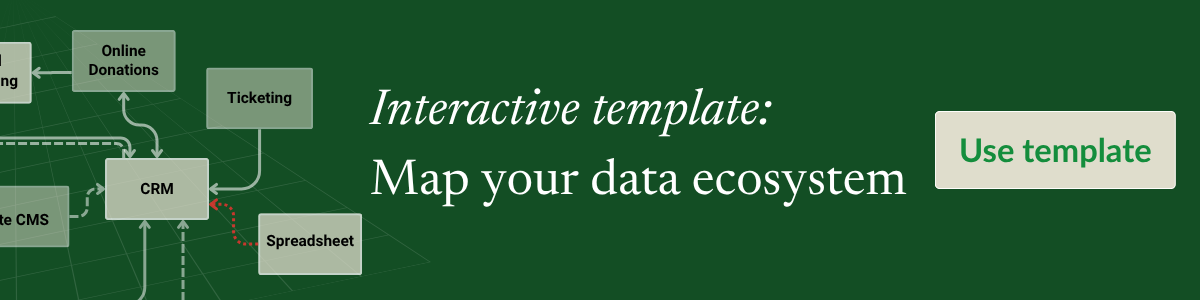
The foundation of any data-driven fundraising strategy starts with a clear audit of your existing data infrastructure. We built a free Data Mapping Template specifically to make this audit fast and actionable, so you can visualize exactly how data is collected, how it moves through your organization, and where the gaps and lags in your process are. Just knowing how your data currently functions is a significant first step.
Focus on data hygiene
Dirty data can grind your whole system to a halt, and it compounds over time.
Develop a regular cadence for reviewing your organization's data hygiene and managing duplicate records. A clean, reliable database isn't just a nice-to-have; it's the prerequisite for every other data-driven strategy. You cannot segment accurately, report reliably, or automate effectively on top of dirty data.
Build your reporting infrastructure
Once your data is unified and clean, create the reports and alerts that make insights automatic and effortless.
Set up your reporting layer so that you can check it every day without having to put in manual effort. The goal is to be immediately aware of what's happening in your donor base, like new major gift signals, at-risk renewal patterns, and first-year members who haven't visited since joining, rather than discovering these things weeks after the response window has passed.
Create a data-driven action plan
The most important step is figuring out how your workflows need to change.
If your team is currently working off of static appeal calendars and one or two standard contact lists regardless of what your data says, a data-driven system requires a fundamentally different way of working. This might look like:
- Building automations triggered when supporters take specific actions
- Adding more personalized segments to campaigns based on behavioral signals
- Integrating more responsive, data-informed planning into regular team workflows
When you're ready for this step, you can use our free Donor Journey Mapping Template to start mapping multi-channel engagement strategies that reach every supporter with the right message at the right time.
Why data-driven fundraising is worth the effort
None of this is theoretical. With consolidated data, you can answer questions about donor behavior in real time, in the middle of a board meeting. It means your mid-level donors aren't getting the same emails as your first-time donors. It means your team spends time communicating and building relationships rather than manually reconciling data from systems that were never designed to talk to each other.
Data consolidation is the foundation that every other technology investment depends on. Without it, even the best fundraising tools produce fragmented results. With it, every system you use becomes part of a coherent picture of each supporter's relationship with your organization.
No matter what tools you're currently using, you can work toward the goal of data-driven fundraising. But if you're serious about moving from storing data to actually using it, one of the highest-leverage investments you can make is in an integration-first CRM specifically designed to consolidate supporter data, surface insights, and help you automate multi-channel engagement journeys. Humanitru is the only nonprofit CRM built to consolidate supporter data across every platform your organization uses, without asking you to give up the tools that work. See how it works →