
Every supporter relationship begins with a spark of interest, from the moment a first-time donor finds your cause, to the second a museum visitor walks through the door. Creating that spark is a significant task on its own, but it is only the beginning for nonprofits invested in building sustainable supporter communities.
What happens after that first impression? For most organizations, engagement strategies are a patchwork, cobbled together over the years by multiple people and departments, using multiple tools and data sources. Without cohesively planned donor journeys, those new supporters, full of excitement and energy, often slip through the cracks.
The donor journey map is a blueprint that ensures your team stays aligned, and every supporter feels seen, understood, and valued from their very first interaction with your organization.
1. Assess your data foundation
First things first. You can’t map a donor journey if you don’t have visibility into the stops along the way. Like many great experiences, donor journeys aren’t always linear. Siloed data often makes it easy to miss crucial information about the way a supporter relationship is progressing, with data from ticket sales, memberships, volunteer and event participation, donations, and online interactions all stored in separate platforms.
For the most effective journey building, you’ll want your data consolidated into a central CRM where you can get a 360-degree view of each supporter. This will give you insight into how each contact is interacting with your organization, no matter what path they choose. This visibility is crucial for preventing disconnected and disjointed experiences, like the awkward moment when you ask a long-time volunteer for a donation using the same approach that you would for a brand new email subscriber.
2. Define targeted supporter segments
Not all journeys look the same. A student visiting a museum on a field trip requires a different “next step” than a high-net-worth individual attending a gala as a guest of one of your long-time donors.
Effective donor journey mapping relies on effective segmentation to group supporters by behaviors and interests. When you have consolidated information about your supporters, you can plan different engagement journeys based on the various points of entry a contact may have to your organization, including signing up for an email list, making a donation, visiting or attending an event, signing up to volunteer, and more.
Defining these segments early will help you define clear engagement goals, moving visitors to members, subscribers to donors, and transforming sparks of interest to lifetime passions.
3. Plan your journeys
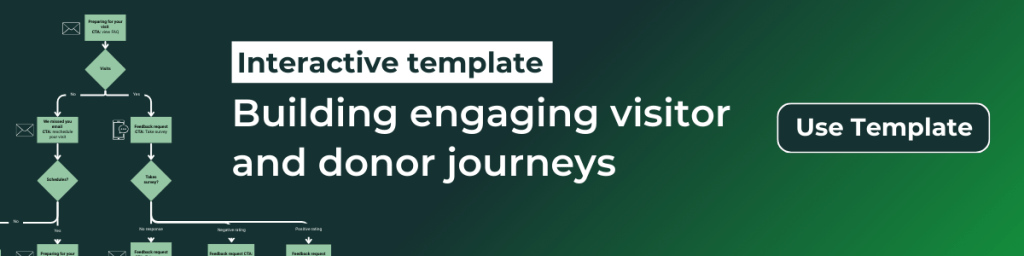
Once your data foundation is solid and your supporter segments are defined, it’s time to plan out your journeys. This is the fun part! Start with one segment or entry point, and think through what you want their “second impression” of your organization to be. Use branched workflows to plan different strategies based on a supporter’s response – following-up when needed, showing gratitude when appropriate, and of course, moving contacts to the next step when they are ready.
This process is often easier said than done – you may need to involve multiple teams and stakeholders in order to coordinate the execution of donor journeys that span channels and programs. Getting everyone involved in planning out donor journeys may take a little coordination, but it will be well worth it when everyone in your organization is aligned and working toward the same goals.
4. Leverage automation to save time and capacity
While the term “automation” might conjure mental images of robots and computers, when used correctly it can be a powerful tool for personalization and building connection. Automation allows you to send the right message at the right time for each supporter, as they progress on their journeys at their own pace. While most organizations don’t have the resources to give every single supporter one-on-one attention, automation can create a similar experience for your donors, where they feel seen, appreciated, and acknowledged.
Automated workflows often involve both external communications, such as triggered email series that welcome and thank new donors, and internal notifications, like alerts prompting personal outreach when a major donor prospect signs up to volunteer. Evaluate your journey map to determine which steps can be easily automated, and lean on your CRM’s consolidated supporter data and automation tools to set up engagement workflows that can be triggered whenever a supporter is ready.