
Food banks operate under a set of pressures that few other nonprofits face. From large volumes of in-kind gifts, unique relationships with corporate partners, and complex volunteer and event structures, food bank staff are presented with challenging data scenarios on a regular basis. On top of that, the urgency of the mission means that every dollar, and every donor relationship, counts more than ever. Food bank development teams are frequently lean, expected to manage thousands of active donors, coordinate massive volunteer workforces, steward corporate food drive partners, and pursue major gifts, all simultaneously.
The right technology stack makes data and processes manageable, so that staff can focus on strategic and relationship-oriented work. When your CRM is connected to your online giving platform, your volunteer management system, and your accounting software, development staff spend less time moving data between systems and more time building the donor relationships that sustain the mission. Siloed tools are the enemy: a donor who gives online, volunteers at a food sort, and participates in a corporate food drive should appear as one unified constituent in your system, not three separate records. These are the data and fundraising tools we recommend for food banks.
Best CRMs for Food Banks
For food banks, the CRM challenge is less about data variety and more about data volume. Thousands of donors giving at relatively modest amounts, combined with large volunteer databases and complex corporate partnership records, demand a system that can handle scale without sacrificing usability. The right CRM consolidates all of this into clean constituent profiles that help small development teams prioritize their time and energy.
Humanitru
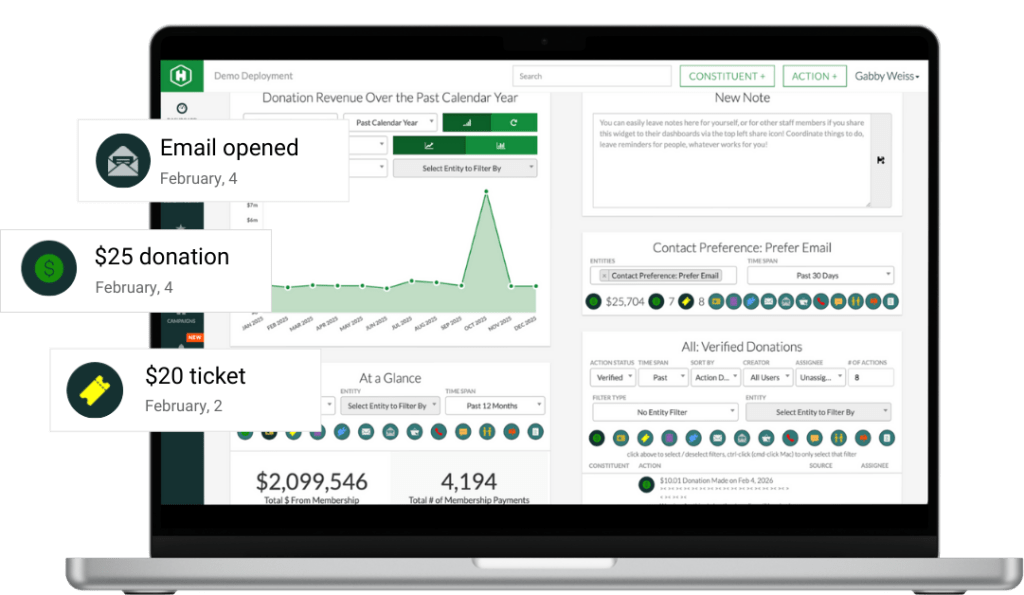
Humanitru’s modern data infrastructure is well-suited to the high-volume, relationship-driven nature of food bank fundraising. Its integration-first philosophy means that whether your donors are giving online, responding to a direct mail appeal, or showing up to volunteer at a food sort, all of that activity flows into a single constituent profile, giving your team the complete picture they need to identify upgrade opportunities, lapsed donor segments, and major gift prospects hiding in your annual fund.
For food banks managing thousands of active donors at a range of gift levels, Humanitru’s automation and stewardship tools are particularly valuable. Personalized acknowledgment workflows, recurring giving management, and smart segmentation allow lean development teams to deliver thoughtful, timely donor communication at scale, without manual intervention for every touchpoint.
Runners Up: Humanitru isn’t the only strong CRM option for food banks. Salesforce Nonprofit Success Pack (NPSP) is a widely used option in the hunger relief sector, offering deep customizability for organizations with dedicated CRM administrators or Salesforce consultants on staff, and Blackbaud’s Raiser’s Edge NXT remains a common choice at larger food banks with established development operations.
Online Donations & Fundraising for Food Banks
Online giving is the lifeblood of most food bank individual donor programs. Emergency response campaigns, Giving Tuesday pushes, and year-end appeals all depend on donation pages that convert visitors efficiently—especially on mobile, where an increasing share of charitable giving now happens. Friction in the giving process is a direct threat to revenue.
Fundraise Up is one of the strongest options for food banks looking to maximize online donation conversion. Their AI-powered checkout optimization, support for modern payment methods (Apple Pay, Google Pay, Venmo), and robust recurring giving tools are particularly well-matched to food bank fundraising, where converting one-time emergency donors into sustaining monthly supporters is one of the highest-ROI moves a development team can make. Learn more at fundraiseup.com.
GoFundMe Pro (formerly Classy) provides polished, conversion-optimized donation pages trusted by some of the largest hunger relief organizations in the country. Its peer-to-peer fundraising tools are especially valuable for food banks running community food drives or employee giving campaigns, where supporters fundraise on behalf of the organization. Learn more at pro.gofundme.com.
Email Marketing Platforms for Food Banks
Email is one of the most cost-effective channels in the food bank fundraising toolkit, driving a significant share of annual fund revenue through appeal campaigns, emergency response asks, and recurring donor stewardship. The best platforms help food banks move beyond mass blasts toward segmented, behavior-triggered communication that feels personal even at high volume.
Mailchimp is a reliable and accessible starting point for food banks building out their email program. Its segmentation tools make it easy to send differentiated communications to one-time donors, monthly sustainers, lapsed donors, and volunteers—a critical capability when your list spans thousands of contacts with very different relationships to your organization. Learn more at mailchimp.com.
Constant Contact is a strong option for food banks with small marketing teams that need to produce high-quality communications quickly. Its high deliverability rates, ease of use, and broad template library make it a practical tool for sending professional appeal emails, impact reports, and emergency campaign updates without extensive design resources. Learn more at constantcontact.com.
ActiveCampaign is the right choice for food banks ready to invest in sophisticated automation. Think: automatically triggering a recurring giving upgrade ask after a donor’s third consecutive annual gift, sending a personalized impact report to donors who gave during an emergency campaign, or launching a re-engagement series targeting donors who haven’t given in 18 months. At scale, this kind of automation can meaningfully move retention and upgrade rates. Learn more at activecampaign.com.
Prospect Research Tools for Food Banks
Food banks often have major gift prospects hiding in their annual fund—donors giving at the $250 or $500 level who have the capacity and inclination to give at the $25,000 or $250,000 level, if asked thoughtfully. Wealth screening helps development teams identify these individuals before a competing organization does.
DonorSearch surfaces a prospect’s philanthropic giving history across other nonprofit organizations—the single strongest predictor of future charitable behavior. For food bank major gift officers building their portfolios, this data is invaluable for identifying annual fund donors who are actively engaged in significant giving elsewhere and may be ready for a major gift conversation. Learn more at donorsearch.net.
Windfall provides precise, weekly-updated net-worth data that goes beyond real estate estimates to identify donors with genuine financial capacity. For food banks with large donor databases, Windfall’s screening can help prioritize which annual fund donors to move into a major gift portfolio—a high-leverage use of a lean development team’s time. Learn more at windfall.com.
Volunteer Management for Food Banks
Volunteers are not a peripheral function at food banks—they are an operational necessity. Most food banks rely on tens of thousands of volunteer hours annually to sort and pack food, staff distribution sites, and support fundraising events. Managing that workforce through spreadsheets and email chains creates real operational risk: missed shifts, uncounted hours, and volunteers who fall through the cracks and don’t return.
Critically, volunteers are also one of a food bank’s most underutilized donor pipelines. Research consistently shows that volunteers give at higher rates and larger amounts than non-volunteer donors—but converting them requires tracking their engagement in the same system where you track giving.
VolunteerHub automates the scheduling, hours tracking, and communication workflows that food bank volunteer coordinators spend hours managing manually. Its integration with major CRM platforms is particularly important for food banks: when volunteer activity flows into the same constituent record as giving history, development teams can identify their most deeply engaged supporters and prioritize them for major gift cultivation. Learn more at volunteerhub.com.
Get Connected by Galaxy Digital allows volunteers to self-select shifts and opportunities aligned with their availability and interests, reducing the administrative burden of manual scheduling. Its corporate volunteer partnership tools are especially relevant for food banks, which frequently partner with local businesses for group volunteer days—a relationship that often serves as a gateway to corporate sponsorship and employee giving campaigns. Learn more at galaxydigital.com.
Accounting Platforms for Food Banks
Food bank accounting is complicated by a mix of revenue types—individual donations at high volume, corporate gifts and sponsorships, government grants with strict reporting requirements, in-kind food donations that must be valued and tracked, and program service revenue. Software that handles fund and grant accounting—not just basic bookkeeping—is essential for financial transparency and audit readiness.
QuickBooks is a practical option for smaller food banks that need reliable accounts payable, payroll, and financial reporting in an accessible, widely supported platform. Learn more at quickbooks.intuit.com.
Sage Intacct is a cloud-based financial management platform built for nonprofits managing multiple funds, grants, and reporting requirements simultaneously. For food banks receiving government funding or managing complex restricted grant portfolios, its automated fund accounting and real-time reporting dashboards significantly reduce manual reconciliation and improve audit readiness. Learn more at sage.com.
Choosing the Right Technology for Your Food Bank
For food banks evaluating new technology, integration should be the primary lens. A donor who gives online, volunteers on Saturday, and responds to a year-end mail appeal should appear as a single, complete constituent in your CRM—not as three separate data points in three separate systems. Every tool in your stack should be evaluated on how well it feeds data into that central record.
The second lens is usability. Food bank development and operations teams are almost always lean. A powerful platform that requires a full-time administrator to maintain is often not the right choice, regardless of its feature set. Prioritize tools that staff will actually use consistently, and factor implementation support and training into every buying decision.
Looking for similar guidance for other types of nonprofit organizations? See our guides to the best tools for museums, zoos and aquariums, and botanic gardens.