
Botanic gardens inhabit a distinct corner of the cultural nonprofit world. They are simultaneously public green spaces, living scientific collections, horticultural education centers, and event venues, all while running membership programs, seasonal fundraising campaigns, and increasingly sophisticated development operations. Few other institutions ask development staff to manage plant sale logistics, garden gala ticketing, endowment stewardship, and membership renewals all at once.
That operational complexity demands a technology stack that goes beyond basic donor management. The ideal botanic garden tech ecosystem connects the dots between admissions, event revenue, membership engagement, and major gift cultivation, turning data from every touchpoint into actionable intelligence for the development team. Siloed systems, where admission data never reaches the CRM and volunteer hours live in a forgotten spreadsheet, are the enemy of that goal. These are the tools we recommend.
Best CRMs for Botanic Gardens
For a botanic garden, the CRM must do more than track donors. It needs to consolidate constituent data from across the entire guest experience – admissions, event registrations, plant sales, volunteer shifts, and membership renewals – into a unified view that development staff can act on. The ability to segment and engage constituents based on their specific relationship with the garden is what separates a good CRM from a great one.
Humanitru
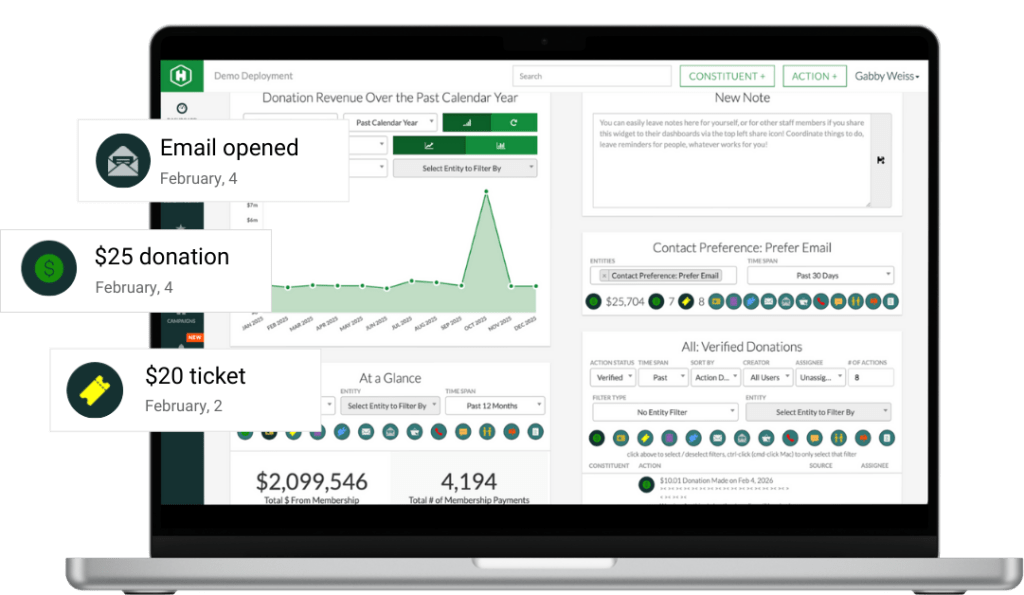
Humanitru’s integration-first architecture is particularly well-suited to botanic gardens, where the technology ecosystem typically spans several specialized platforms. Rather than locking institutions into a single all-in-one system, Humanitru connects your existing tools – ticketing, event management, membership, and accounting – into a single constituent view that fundraisers can actually use.
For botanic garden development teams, this means being able to see a supporter’s full engagement history in one place: how often they visit, whether they’ve attended the annual garden gala, what plant societies or programs they’ve supported, and whether their giving history and wealth profile suggest major gift potential. That kind of holistic visibility powers the personalized stewardship that turns regular garden guests into lifelong donors, without requiring expensive custom builds or database consultants to maintain.
Runners Up: Humanitru isn’t the only strong option for botanic gardens. Salesforce offers near-infinite customizability for institutions with the technical resources to configure and maintain it, and Blackbaud’s Raiser’s Edge NXT is a familiar platform for development teams with established workflows in the Blackbaud ecosystem.
Ticketing & Event Platforms for Botanic Gardens
Botanic gardens generate visitor and revenue data across a wide variety of touchpoints: general admissions, timed-entry for special exhibitions, seasonal events like holiday light walks and plant sales, private event rentals, and educational programs. Each of these represents both a revenue stream and a relationship-building opportunity—but only if the data flows back to the CRM.
ACME Ticketing is a cloud-based visitor management platform built for cultural institutions. Its support for both timed-entry and general admission ticketing, combined with an open API that integrates cleanly with CRM platforms, makes it a strong fit for botanic gardens managing high-volume seasonal events alongside everyday admissions. Learn more at acmeticketing.com.
Ticketure offers a mobile-first ticketing experience that performs especially well for outdoor venues—a natural fit for botanic gardens where guests and staff are frequently moving through large, open-air spaces. Its lightweight platform and strong API keep visitor data flowing to connected systems. Learn more at ticketure.com.
TicketSpice is a flexible, affordable option for gardens needing branded, customizable ticketing pages for specific events—garden galas, holiday light experiences, or ticketed plant sales. Its drag-and-drop builder lets staff create polished event pages without developer support. Learn more at ticketspice.com.
ROLLER combines ticketing, point-of-sale, membership management, and guest feedback tools in a single platform. For botanic gardens with on-site retail (gift shops, plant nurseries) and food and beverage operations, ROLLER’s unified POS and ticketing experience simplifies operations while building a richer picture of each guest’s engagement. Learn more at roller.software.
Centaman is an attraction management platform built for venues where guest experience is paramount. With a dedicated implementation team, 24/7 support, and scalable custom development options, it suits larger botanic gardens with complex operational needs across multiple visitor touchpoints. Learn more at centaman.com.
Eventbrite is a practical, widely recognized option for public-facing events where discoverability matters—outdoor concert series, community plant swaps, or fundraising lectures where reaching new audiences is as important as managing existing guests. Learn more at eventbrite.com/organizer/event-type/npo.
Email Marketing Platforms for Botanic Gardens
Email is a cornerstone of the botanic garden membership and donor engagement cycle. From spring planting season appeals to year-end giving campaigns and member-only event invitations, well-timed, well-targeted email communication drives renewals, upgrades, and donations. The best platforms help gardens move beyond one-size-fits-all newsletters toward personalized, behavior-triggered communication.
Mailchimp is a reliable starting point for gardens building their email program. Its intuitive drag-and-drop builder requires no coding background, and its segmentation tools make it straightforward to send targeted communications to members, lapsed visitors, or event attendees separately. Learn more at mailchimp.com.
Constant Contact is a strong fit for smaller botanic garden teams with lean marketing staff. High deliverability rates and a deep library of professionally designed templates make it easy to produce polished seasonal newsletters, membership renewal reminders, and event announcements without a dedicated designer. Learn more at constantcontact.com.
ActiveCampaign is built for gardens ready to graduate from batch-and-blast email into sophisticated, data-driven automation. Think: automatically enrolling a new member in a welcome series, triggering a plant society membership upsell after a guest attends a horticultural lecture, or launching a re-engagement campaign for lapsed members as the spring season begins. Learn more at activecampaign.com.
Online Donations & Fundraising for Botanic Gardens
From endowment campaigns to annual fund appeals and garden feature sponsorships, online giving is an essential revenue channel for botanic gardens. A frictionless, mobile-optimized donation experience—one that loads quickly and supports modern payment methods—meaningfully increases conversion, particularly during high-traffic seasonal campaigns.
Fundraise Up helps botanic gardens grow online revenue through optimized checkout experiences, support for modern payment methods including Apple Pay and Google Pay, and AI-powered personalization tools. Their recurring giving features are well-suited for gardens cultivating a base of sustaining annual fund donors alongside major gift prospects. Learn more at fundraiseup.com.
GoFundMe Pro (formerly Classy) provides polished, conversion-optimized donation pages for nonprofit organizations. The trusted GoFundMe brand gives donors confidence, and the platform’s flexible campaign tools support everything from general annual fund pages to dedicated endowment or capital campaign microsites. Learn more at pro.gofundme.com.
Prospect Research Tools for Botanic Gardens
Botanic garden members and regular visitors often include individuals with significant philanthropic capacity—people who care deeply about horticulture, conservation, and community green space and who may be natural candidates for major gifts, planned giving, or named endowment opportunities. Prospect research tools help surface these individuals from within your existing constituent database.
DonorSearch provides development teams with a comprehensive picture of a prospect’s charitable giving history across other organizations. Since philanthropic behavior is the strongest predictor of future giving, this data is invaluable for prioritizing outreach and identifying botanic garden members who are actively engaged in major gift giving elsewhere. Learn more at donorsearch.net.
Windfall differentiates itself with precise, weekly-updated net-worth data rather than relying on real estate proxies. For botanic gardens running endowment campaigns or seeking naming gift prospects for conservatories, gardens, or collections, Windfall helps identify members and visitors with significant assets who may not yet have a substantial giving history with your organization. Learn more at windfall.com.
Volunteer Management for Botanic Gardens
Volunteers are central to the botanic garden operating model—from horticultural volunteers maintaining living collections, to education docents leading school programs, to event crews supporting garden galas and plant sales. Coordinating large, seasonally variable volunteer workforces across diverse roles requires more than a shared calendar and email chains.
VolunteerHub automates scheduling, hours tracking, and volunteer communication, reducing the administrative burden on garden staff. Its integration with major CRM platforms ensures volunteer engagement is captured alongside donor and member activity—giving development teams a fuller picture of each constituent’s relationship with the garden. Learn more at volunteerhub.com.
Get Connected by Galaxy Digital allows volunteers to self-select opportunities aligned with their interests, whether that’s horticultural maintenance, education programming, or special event support. Its mobile volunteer app, onsite kiosk check-in, and automated impact reporting make it easy to manage both individual volunteers and corporate volunteer groups. Learn more at galaxydigital.com.
Accounting Platforms for Botanic Gardens
Botanic gardens often manage a complex mix of revenue streams: earned income from admissions, event rentals, gift shop and nursery sales, alongside restricted grants, endowment distributions, and philanthropic contributions. Accounting software that handles fund and grant tracking—not just basic bookkeeping—is essential for maintaining financial clarity and compliance.
QuickBooks is a practical choice for small to mid-size botanic gardens seeking reliable accounts payable, payroll, and financial reporting without the complexity of an enterprise platform. Learn more at quickbooks.intuit.com.
Sage Intacct is a cloud-based financial management platform built for nonprofits managing multiple funds and grant accounts simultaneously. For larger botanic gardens with endowments, restricted capital campaign funds, and complex grant reporting requirements, its real-time dashboards and automated fund accounting reduce manual reconciliation significantly. Learn more at sage.com.
Choosing the Right Technology for Your Botanic Garden
The most important principle when evaluating technology for a botanic garden is integration. A ticketing platform that doesn’t talk to your CRM, or an email tool that can’t segment by membership status, creates data silos that quietly undermine your development program. Before committing to any tool, ask how it connects to your existing ecosystem and what constituent data it will add to your picture.
Just as important: choose tools your team will realistically use. A sophisticated platform with a steep learning curve and no implementation support often ends up abandoned. Involve the staff who will use the system daily—development associates, membership coordinators, event managers—in the evaluation process, and weight usability as heavily as features.
Looking for similar guidance for other cultural institutions? See our guides to the best tools for museums and the best tools for zoos and aquariums.
Post navigation