
January is a natural time for reflection and planning, not only in our personal lives, but also in the professional world. Have you set fundraising resolutions for the new year? No matter what your goals are, you’ll need a firm foundation in place to support you – that’s why we recommend starting the year off with a complete audit of your fundraising infrastructure. Taking stock of where you need updates or improvements now will save you from last-minute scrambles later on in the year, and ensure that every fundraising campaign is set up for success from the beginning.
Here are three high-impact tasks that should be on any fundraiser’s January to-do list.
1. Map your data ecosystem
Data is your most valuable resource: the foundation of the relationships that keep your supporters feeling connected to your organization. In our personal relationships, we mentally collect data every day – we can instantly recall shared experiences, the most recent update we received on our friends’ lives, and their preferences and personalities. For fundraisers managing relationships with thousands of donors, the process is a lot more complicated. Effectively maintaining a CRM as your central source of truth allows you to instantly look up a supporter and similarly understand their personal preferences and relationship history – but this requires a seamlessly integrated tech ecosystem which ensures that every touchpoint a supporter has with your organization can be stored in one, central place.
Unfortunately, most nonprofits suffer from the dreaded data silos that trap information in disjointed platforms and spreadsheets. Without a complete record of your donors’ history, you risk communication that feels disconnected, and in the worst case, disrespectful.
Before you launch your first spring campaign, take a moment to make sure that you know exactly where your organization’s data lives and how it moves between teams and platforms. It is important to revisit this process each year, as your team may have added new systems or started collecting new data.
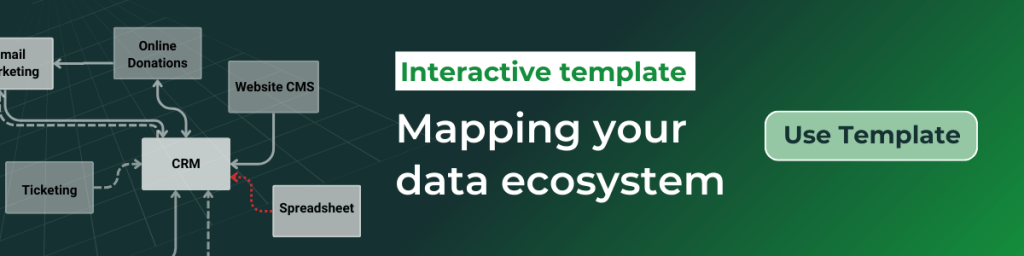
Before you start, download our interactive data mapping template to create your own data diagram.
To audit and map your data:
- Inventory your platforms
Where is supporter data currently stored? List every tool used, including those used by other teams or departments. Common tools include: your CRM, email marketing platform, online fundraising tools, ticketing platform, event software, volunteer management software, payment processor, and accounting platform. - Map the flow of data
Once you’ve identified all of the platforms in use, start building an interconnected map that notes entry points for new contacts and the integrations that connect your platforms together. This step is crucial for identifying gaps, such as platforms that don’t integrate, incomplete integrations, or even data that simply lives in spreadsheets outside of the connected ecosystem. - Identify and address issue areas
Once you’ve mapped out your data, you’ll have a clear guide to areas where data is incomplete or falling through the cracks. Now, it’s time to plan your solutions. Data silos often aren’t easy to fix, but you may consider creating a schedule for regular manual exports and uploads between platforms, talking to your technology providers to see if an integration is on their roadmap, or exploring custom integration solutions through an open API or third-party technology.
2. Audit your acquisition experiences
Before you can nurture a supporter, you have to successfully acquire them. Many organizations lose potential supporters at the “digital front door” because of a clunky user experience on their website.
Put yourself in a supporter’s shoes and test the full experience:
- Ask a search engine or LLM a question that would lead to someone discovering your organization, such as “nonprofits that support immigration reform” or “is there a science museum in Raleigh, North Carolina?” Are they able to easily find your website?
- Once they click the link to visit your website, do they have to wait for the page to load? Does the homepage content immediately capture their attention and clearly communicate who you are?
- Can they easily find options for taking action, including making a donation, purchasing a ticket, or signing up for your email list?
- Does your donation page load in under 3 seconds? Does your form offer options for monthly giving and streamlined payment options such as ApplePay? This page is crucial, and a clunky or confusing experience can cause potential supporters to drop off.
- Finally, try it all again on a mobile device!
As you go through the experience, note any points that feel unclear or confusing, take a large amount of time, or require excessive steps to complete.
3. Update your donor journeys
For most nonprofits, donor journeys weren’t originally planned in a structured and cohesive manner. Instead, bits and pieces were built and evolved over time, often resulting in a patchwork of automations, triggers, and nurture workflows that may span multiple platforms and data sources. Now that you’ve audited your data platforms and supporter entry points, you’re ready to map out a cohesive, integrated experience that will welcome and nurture new supporters.
Start this process by mapping out the various “entry points” that supporters have to your organization, such as signing up to an email list, buying a ticket, making a donation, attending an event, etc. For each entry point, determine the ideal next milestone(s) that you would like your supporters to achieve. For instance, if someone visits your museum, the next step of engagement may be becoming a member or donor, while for a new donor, making a second gift is a crucial indicator that they will continue supporting your organization for the long-term.
![building engaging donor journeys [template]](https://cdn.prod.website-files.com/698241a9b516516506d194cb/69a8f1738012aa27d52c0a29_Blog-CTAs-1-1024x256.png)
Now that you have a destination in mind for these supporters, you’ll need to lead them on a journey between the two points. List out what you’ll need to learn about them, what they’ll need to learn about you, and the “stepping-stone” opportunities they’ll have along the way. These are the building blocks of creating an engaging nurture journey – for instance, for a first-time visitor to a museum:
You might want them to learn about:
- Your upcoming exhibitions
- Your community engagement programming
- Your mission and impact
You might want to learn:
- The subjects that most interest them
- Their preferred communication channel and frequency
- Their age, family, or profession (Are they a student? A young professional? A parent that visits with their children? A retiree?)
Engagement options they might be interested in:
- Receiving a specialized email newsletter
- Visiting the museum again
- Attending an event
- Joining a volunteer program
With this information, you’re ready to start planning, building, and automating your donor journey. Take stock of your existing nurture flows, and update or rebuild them as needed to create a seamless, personalized journey for each supporter.
No matter what your goals for the new year are, success depends on having a strong foundation on which to build your campaigns. By ensuring that your data is consolidated, your “first impression” experiences are smooth and inviting, and your subsequent engagements build true connections and inspire further involvement, you’ll be setting yourself up for successful campaigns throughout the rest of the year.